Buy personal-coaching.eu ?
We are moving the project
personal-coaching.eu .
Are you interested in purchasing the domain
personal-coaching.eu ?
domain@kv-gmbh.de · 0541-91531010
Buy personal-coaching.eu ?
What is the difference between linear growth and proportional growth?
Linear growth occurs when a quantity increases by the same amount over a given time period, resulting in a straight line on a graph. Proportional growth, on the other hand, occurs when a quantity increases by a constant proportion or percentage over time, resulting in a curved line on a graph. In linear growth, the increase is constant, while in proportional growth, the rate of increase changes as the quantity grows. **
What is the difference between proportional and inverse proportional?
Proportional and inverse proportional relationships are two types of relationships between two variables. In a proportional relationship, as one variable increases, the other variable also increases at a constant rate. This means that the ratio between the two variables remains the same. In an inverse proportional relationship, as one variable increases, the other variable decreases at a constant rate. This means that the product of the two variables remains constant. **


Similar search terms for Non-proportional
Top-Angebote
Products related to Non-proportional:
-
JoyToys RC Drift Car Mini Remote Control Drift Racer With Full Proportional Steering blackExperience the thrill of precision drifting right on your desk with this mini remote control car built for endless fun. Designed for kids, hobbyists, and RC enthusiasts, this compact 1:64 scale RC car delivers realistic full proportional steering...37,97 $*Shipping: 0,00 $Secure redirect to the provider
-
Rupa Publications You Can by George Matthew Adams - Motivational Self-Help Paperback - Classic Personal Growth Guide - Non-FictionYou Can by George Matthew Adams is a concise self-help paperback drawn from decades of the author's syndicated newspaper columns. Written as short, encouraging essays, it guides readers past fear, self-doubt, and hesitation toward practical daily habits that build confidence and resilience. This edition brings Adams's plainspoken wisdom to a new generation of readers looking for motivation, focus, and lasting positive change. The book unfolds as short, persuasive essays that guide readers past common psychological barriers such as fear, procrastination, and negative self-talk, toward habits that support real achievement. Adams writes in a warm, conversational yet authoritative voice that blends anecdote with memorable aphorisms, making his ideas feel immediately usable.2,99 £*Shipping: 2,99 £Secure redirect to the provider
-
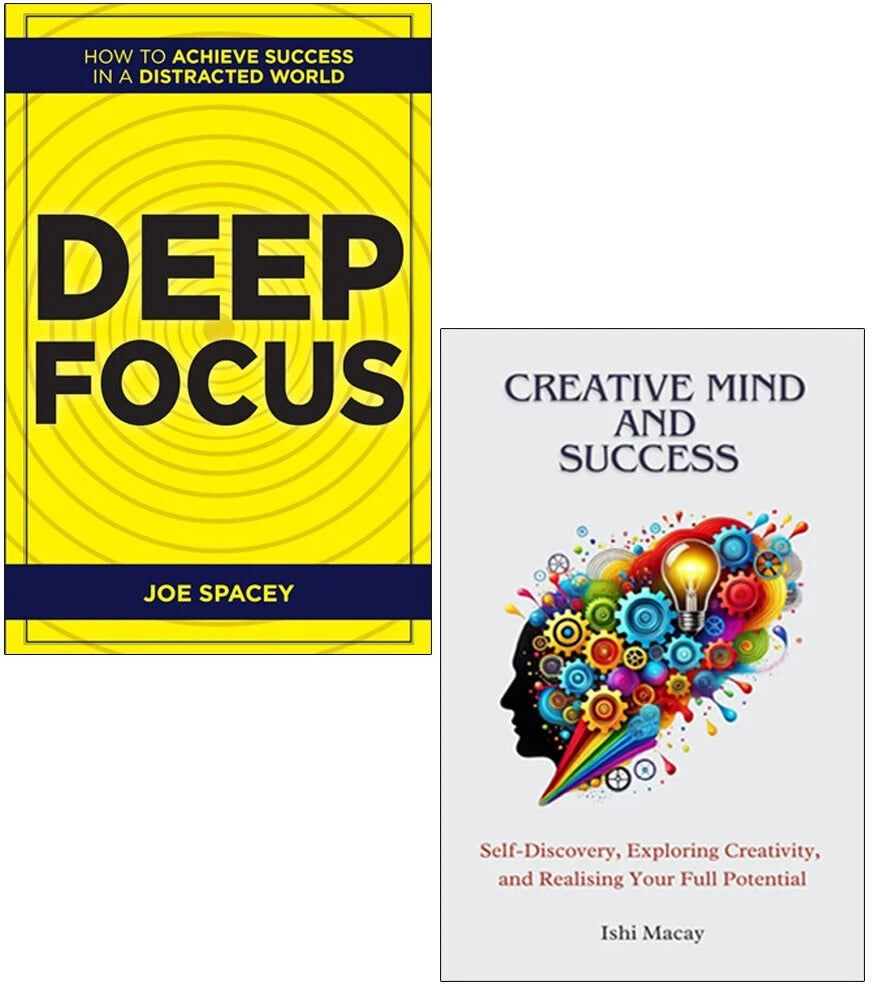
Various Publishers Deep Focus & Creative Mind And Success 2 Books Collection Set - Joe Spacey & Ishi Macay - Paperback - Self-Help & Personal Growth BundleThis 2-book collection set includes 'Deep Focus: How to Achieve Success in a Distracted World' and 'Creative Mind And Success: Self-Discovery, Exploring Creativity, and Realising Your Full Potential'. 'Deep Focus' by Joe Spacey addresses the issue of distraction in today's world, while 'Creative Mind And Success' by Ishi Macay explores how imagination can fuel achievement. The books are published by Rupa Publications India and The Readers Paradise ltd, and are suitable for adult readers. The set is a brand new paperback bundle, making it an ideal gift for students, professionals, and anyone looking to build a personal growth library.7,99 £*Shipping: 2,99 £Secure redirect to the provider
-
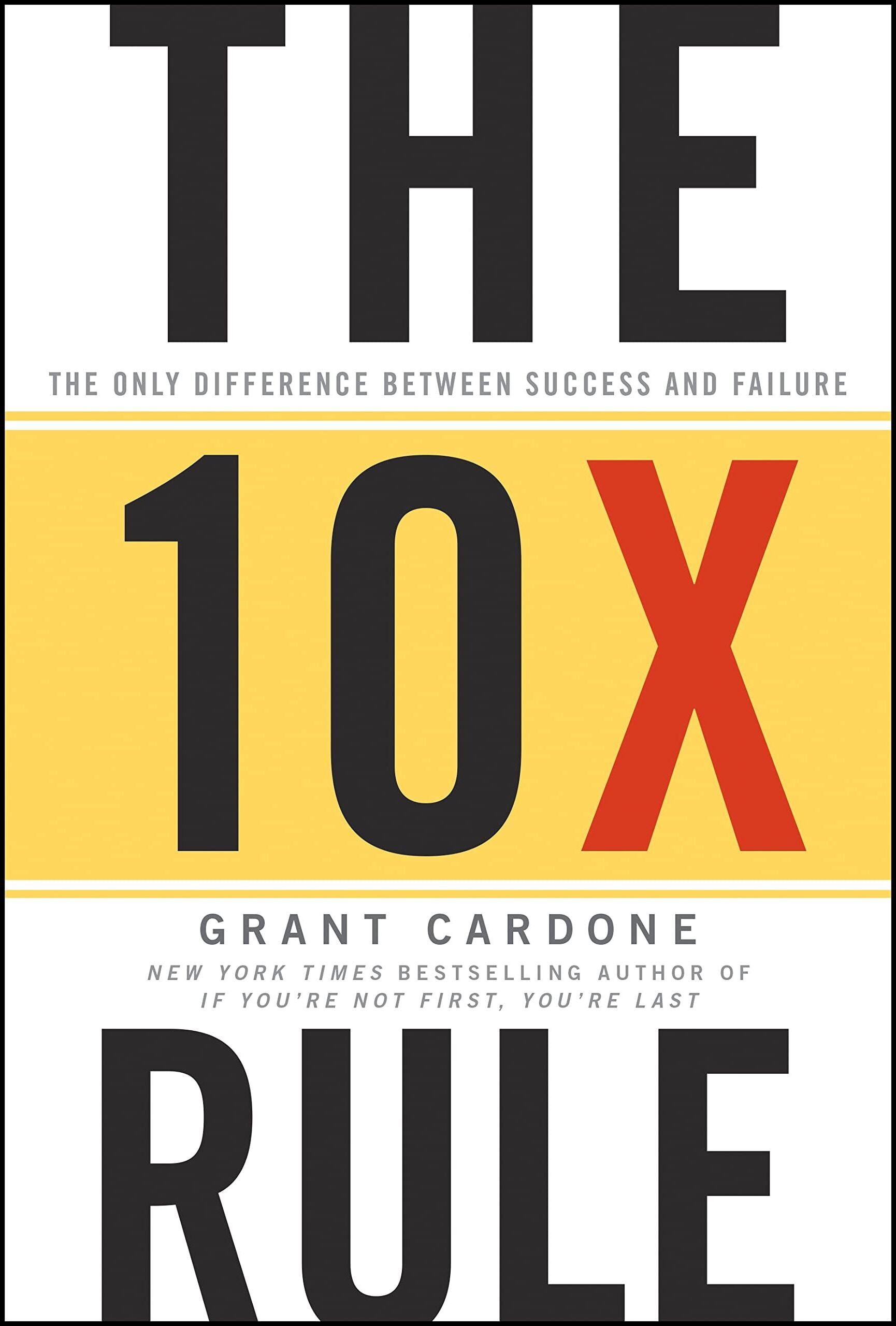
Wiley The 10X Rule: The Only Difference Between Success and Failure by Grant Cardone Motivation, Business & Self-Improvement BestsellerAchieve "Massive Action" results and accomplish your business dreams! While most people operate with only three degrees of action-no action, retreat, or normal action-if you're after big goals, you don't want to settle for the ordinary. To reach the next level, you must understand the coveted 4th degree of action. This 4th degree, also know as the 10 X Rule, is that level of action that guarantees companies and individuals realize their goals and dreams. The 10 X Rule unveils the principle of "Massive Action," allowing you to blast through business clichés and risk-aversion while taking concrete steps to reach your dreams. It also demonstrates why people get stuck in the first three actions and how to move into making the 10X Rule a discipline. Find out exactly where to start, what to do, and how to follow up each action you take with more action to achieve Massive Action results. Learn the "Estimation of Effort" calculation to ensure you exceed your targets Make the Fourth Degree a way of life and defy mediocrity Discover the time management myth Get the exact reasons why people fail and others succeed Know the exact formula to solve problems Extreme success is by definition outside the realm of normal action. Instead of behaving like everybody else and settling for average results, take Massive Action with The 10 X Rule, remove luck and chance from your business equation, and lock in massive success.15,99 £*Shipping: 2,99 £Secure redirect to the provider


-
How can one recognize proportional and inverse proportional relationships?
Proportional relationships can be recognized when two quantities increase or decrease at the same rate. This means that when one quantity doubles, the other quantity also doubles. Inverse proportional relationships, on the other hand, can be recognized when one quantity increases while the other decreases at a constant rate, or vice versa. This means that when one quantity doubles, the other quantity is halved. One can recognize these relationships by plotting the data on a graph and observing if the points form a straight line through the origin for proportional relationships, or if the points form a curve for inverse proportional relationships. **
-
What is the difference between proportional relationships and inverse proportional relationships?
Proportional relationships are those in which the two variables increase or decrease at a constant rate. In other words, when one variable doubles, the other variable also doubles. In contrast, inverse proportional relationships are those in which one variable increases as the other decreases, and vice versa. In an inverse proportional relationship, the product of the two variables remains constant. In other words, when one variable doubles, the other variable is halved. **
-
What are proportional relationships?
Proportional relationships are relationships between two quantities where they change in a consistent manner. This means that as one quantity increases or decreases, the other quantity also increases or decreases in a predictable way. In a proportional relationship, the ratio between the two quantities remains constant. This can be represented by a straight line when graphed. **
-
Which of the assignments is inversely proportional and which is directly proportional?
The assignment of distance traveled and time taken is inversely proportional, as the distance traveled decreases as the time taken increases. On the other hand, the assignment of force and acceleration is directly proportional, as the force increases, the acceleration also increases. **


How can I recognize if a function is proportional or inversely proportional?
You can recognize if a function is proportional by checking if the ratio of the output to the input is constant. In other words, if the function can be written in the form y = kx, where k is a constant, then the function is proportional. On the other hand, if the function can be written in the form y = k/x, where k is a constant, then the function is inversely proportional. Additionally, if the graph of the function is a straight line passing through the origin, it is proportional, while if the graph is a hyperbola, it is inversely proportional. **
Which of the relationships is inversely proportional and which is directly proportional?
The relationship between the distance traveled and the time taken is inversely proportional, as the faster you travel, the less time it takes to reach a destination. On the other hand, the relationship between the force applied and the acceleration produced is directly proportional, as increasing the force applied will result in a corresponding increase in acceleration. **
Top-Angebote
Products related to Non-proportional:
-
Wilco Publishing Think and Grow Rich by Napoleon Hill Classic Personal Development, Success, Wealth, Mindset & Motivation Self Help BookDiscover one of the most influential personal development classics with Think and Grow Rich by Napoleon Hill. Originally published in 1937, Think and Grow Rich explores the principles and habits Hill associated with achievement, ambition, persistence, goal setting and personal success. Rather than focusing solely on money, the book examines how mindset, clear goals, determination and consistent action can influence progress towards personal and professional ambitions. Hill presents principles intended to help readers develop greater focus, confidence and persistence when pursuing their goals. A longstanding classic in the fields of self-help, motivation, business and personal development, Think and Grow Rich remains popular with entrepreneurs, professionals and readers interested in improving their approach to achievement and success. Whether you're building a personal development library, looking for motivational reading or searching for a gift for an aspiring entrepreneur, this enduring classic is an excellent choice. Key Features Classic personal development book by Napoleon Hill Focuses on success, mindset and goal setting Explores motivation, persistence and achievement Popular with entrepreneurs and business readers Ideal for self-improvement and motivational reading Timeless addition to a personal development library Great gift for business and self-help readers2,99 £*Shipping: 1,99 £Secure redirect to the provider
-
Rupa Publications Success Through a Positive Mental Attitude by Napoleon Hill & W. Clement Stone - Paperback - Self-Help Classic for Personal Growth & SuccessSuccess Through a Positive Mental Attitude is a timeless self-help classic co-written by Napoleon Hill, author of Think and Grow Rich, and self-made insurance millionaire W. Clement Stone. First published decades ago, the book distills the authors' famous 'PMA' philosophy into practical, actionable steps. This brand-new paperback edition, published by Rupa Publications, brings one of the most influential personal-development books of the century to readers seeking motivation and direction. Napoleon Hill and W. Clement Stone teamed up to create one of the most enduring partnerships in the personal development world, and the result was a book that has helped millions of readers unlock their hidden potential. At its heart is the idea of the 'invisible talisman' every person carries: on one side, the letters PMA for Positive Mental Attitude; on the other, the potential for personal growth and success.2,99 £*Shipping: 2,99 £Secure redirect to the provider
-
JoyToys RC Drift Car Mini Remote Control Drift Racer With Full Proportional Steering blackExperience the thrill of precision drifting right on your desk with this mini remote control car built for endless fun. Designed for kids, hobbyists, and RC enthusiasts, this compact 1:64 scale RC car delivers realistic full proportional steering...37,97 $*Shipping: 0,00 $Secure redirect to the provider
-
Rupa Publications You Can by George Matthew Adams - Motivational Self-Help Paperback - Classic Personal Growth Guide - Non-FictionYou Can by George Matthew Adams is a concise self-help paperback drawn from decades of the author's syndicated newspaper columns. Written as short, encouraging essays, it guides readers past fear, self-doubt, and hesitation toward practical daily habits that build confidence and resilience. This edition brings Adams's plainspoken wisdom to a new generation of readers looking for motivation, focus, and lasting positive change. The book unfolds as short, persuasive essays that guide readers past common psychological barriers such as fear, procrastination, and negative self-talk, toward habits that support real achievement. Adams writes in a warm, conversational yet authoritative voice that blends anecdote with memorable aphorisms, making his ideas feel immediately usable.2,99 £*Shipping: 2,99 £Secure redirect to the provider
-
What is the difference between linear growth and proportional growth?
Linear growth occurs when a quantity increases by the same amount over a given time period, resulting in a straight line on a graph. Proportional growth, on the other hand, occurs when a quantity increases by a constant proportion or percentage over time, resulting in a curved line on a graph. In linear growth, the increase is constant, while in proportional growth, the rate of increase changes as the quantity grows. **
-
What is the difference between proportional and inverse proportional?
Proportional and inverse proportional relationships are two types of relationships between two variables. In a proportional relationship, as one variable increases, the other variable also increases at a constant rate. This means that the ratio between the two variables remains the same. In an inverse proportional relationship, as one variable increases, the other variable decreases at a constant rate. This means that the product of the two variables remains constant. **
-
How can one recognize proportional and inverse proportional relationships?
Proportional relationships can be recognized when two quantities increase or decrease at the same rate. This means that when one quantity doubles, the other quantity also doubles. Inverse proportional relationships, on the other hand, can be recognized when one quantity increases while the other decreases at a constant rate, or vice versa. This means that when one quantity doubles, the other quantity is halved. One can recognize these relationships by plotting the data on a graph and observing if the points form a straight line through the origin for proportional relationships, or if the points form a curve for inverse proportional relationships. **
-
What is the difference between proportional relationships and inverse proportional relationships?
Proportional relationships are those in which the two variables increase or decrease at a constant rate. In other words, when one variable doubles, the other variable also doubles. In contrast, inverse proportional relationships are those in which one variable increases as the other decreases, and vice versa. In an inverse proportional relationship, the product of the two variables remains constant. In other words, when one variable doubles, the other variable is halved. **
Similar search terms for Non-proportional
-
Various Publishers Deep Focus & Creative Mind And Success 2 Books Collection Set - Joe Spacey & Ishi Macay - Paperback - Self-Help & Personal Growth BundleThis 2-book collection set includes 'Deep Focus: How to Achieve Success in a Distracted World' and 'Creative Mind And Success: Self-Discovery, Exploring Creativity, and Realising Your Full Potential'. 'Deep Focus' by Joe Spacey addresses the issue of distraction in today's world, while 'Creative Mind And Success' by Ishi Macay explores how imagination can fuel achievement. The books are published by Rupa Publications India and The Readers Paradise ltd, and are suitable for adult readers. The set is a brand new paperback bundle, making it an ideal gift for students, professionals, and anyone looking to build a personal growth library.7,99 £*Shipping: 2,99 £Secure redirect to the provider
-
Wiley The 10X Rule: The Only Difference Between Success and Failure by Grant Cardone Motivation, Business & Self-Improvement BestsellerAchieve "Massive Action" results and accomplish your business dreams! While most people operate with only three degrees of action-no action, retreat, or normal action-if you're after big goals, you don't want to settle for the ordinary. To reach the next level, you must understand the coveted 4th degree of action. This 4th degree, also know as the 10 X Rule, is that level of action that guarantees companies and individuals realize their goals and dreams. The 10 X Rule unveils the principle of "Massive Action," allowing you to blast through business clichés and risk-aversion while taking concrete steps to reach your dreams. It also demonstrates why people get stuck in the first three actions and how to move into making the 10X Rule a discipline. Find out exactly where to start, what to do, and how to follow up each action you take with more action to achieve Massive Action results. Learn the "Estimation of Effort" calculation to ensure you exceed your targets Make the Fourth Degree a way of life and defy mediocrity Discover the time management myth Get the exact reasons why people fail and others succeed Know the exact formula to solve problems Extreme success is by definition outside the realm of normal action. Instead of behaving like everybody else and settling for average results, take Massive Action with The 10 X Rule, remove luck and chance from your business equation, and lock in massive success.15,99 £*Shipping: 2,99 £Secure redirect to the provider
-
Vermilion Dale Carnegie Personal Development Collection – 6 Book Set Self-Help, Communication & Success ClassicsDale Carnegie Personal Development Collection 6 Books Set Transform your mindset, confidence, and communication skills with the Dale Carnegie Personal Development – 6 Books Collection Set by Dale Carnegie. This powerful collection brings together some of Carnegie’s most influential works on success, relationships, leadership, and personal growth. Known for his timeless principles and practical advice, Carnegie’s teachings have helped millions of readers improve their confidence, build meaningful relationships, and achieve their goals. Perfect for professionals, students, entrepreneurs, and anyone looking to grow personally and professionally, this set offers a complete guide to mastering communication and success. Why Readers Love This Collection: Includes 6 bestselling personal development books Timeless advice on communication, confidence, and leadership Easy-to-understand, practical strategies Ideal for beginners and experienced readers Perfect for self-improvement and career growth A must-have for anyone serious about personal development, the Dale Carnegie Collection delivers proven principles for success in life and work. Description How to Develop Self-confidence and Influence People by Public Speaking Drawing on Dale years of experience as a business trainer this book will show you how to overcome the natural fear of public speaking, to become a successful speaker and even learn to enjoy it. How To Stop Worrying And Start Living Worry affects everyone and descends with ease upon work, money, family life and relationships. This book offers practical strategies for breaking out of this destructive before it breaks you. How To Enjoy Your Life And Job Life is very much what we make it, and since most of us spend the greater part of our lives at work, it follows that we should be making the best of our working lives. This book demonstrates that anyone can achieve greater satisfaction in both their home life and their job by learning to integrate business, social and personal . The Quick And Easy Way To Effective Speaking Good public speakers are made, not born - or so thinks Dale Carnegie, the pioneer of personal business skills. Yet business, social and personal satisfaction depend heavily upon a persons ability to communicate clearly. Public speaking is an important skill which anyone can acquire and develop. The Art of Public Speaking Carnegie draws upon his experience as a salesman and lecturer to counsel readers on how to overcome self-consciousness and express themselves in an easy-to-understand, high-impact manner. How to Win Friends and Influence People His advice has stood the test of time and will teach you how to make friends quickly and easily, increase your popularity, persuade people to follow your way of thinking, enable you to win new clients and customers, become a better speaker, boost enthusiasm among your colleagues. Tags; Dale Carnegie Books10,99 £*Shipping: 2,99 £Secure redirect to the provider
-
Piatkus The Way of Integrity by Martha Beck – Self-Discovery, Purpose & Personal Growth GuideBestselling author, life coach and sociologist Martha Beck explains why 'integrity' - being in harmony with ourselves - is the key to a meaningful and joyful life In The Way of Integrity, Beck presents a four-stage process that anyone can use to find integrity, and with it, a sense of purpose, emotional healing, and a life free of mental suffering. Much of what plagues us-people pleasing, staying in stale relationships, negative habits-all point to what happens when we are out of touch with what truly makes us feel whole. Inspired by The Divine Comedy, Beck uses Dante's classic hero's journey as a framework to break down the process of attaining personal integrity into small, manageable steps. She shows how to read our internal signals that lead us towards our true path, and to recognize what we actually yearn for versus what our culture sells us. With techniques tested on hundreds of her clients, Beck brings her expertise as a social scientist, life coach and human being to help readers to uncover what integrity looks like in their own lives. She takes us on a spiritual adventure that not only will change the direction of our lives, but bring us to a place of genuine happiness.6,95 £*Shipping: 2,99 £Secure redirect to the provider
-
What are proportional relationships?
Proportional relationships are relationships between two quantities where they change in a consistent manner. This means that as one quantity increases or decreases, the other quantity also increases or decreases in a predictable way. In a proportional relationship, the ratio between the two quantities remains constant. This can be represented by a straight line when graphed. **
-
Which of the assignments is inversely proportional and which is directly proportional?
The assignment of distance traveled and time taken is inversely proportional, as the distance traveled decreases as the time taken increases. On the other hand, the assignment of force and acceleration is directly proportional, as the force increases, the acceleration also increases. **
-
How can I recognize if a function is proportional or inversely proportional?
You can recognize if a function is proportional by checking if the ratio of the output to the input is constant. In other words, if the function can be written in the form y = kx, where k is a constant, then the function is proportional. On the other hand, if the function can be written in the form y = k/x, where k is a constant, then the function is inversely proportional. Additionally, if the graph of the function is a straight line passing through the origin, it is proportional, while if the graph is a hyperbola, it is inversely proportional. **
-
Which of the relationships is inversely proportional and which is directly proportional?
The relationship between the distance traveled and the time taken is inversely proportional, as the faster you travel, the less time it takes to reach a destination. On the other hand, the relationship between the force applied and the acceleration produced is directly proportional, as increasing the force applied will result in a corresponding increase in acceleration. **
* All prices are inclusive of VAT and, if applicable, plus shipping costs. The offer information is based on the details provided by the respective shop and is updated through automated processes. Real-time updates do not occur, so deviations can occur in individual cases. ** Note: Parts of this content were created by AI.